

Quality control in injection molding is the set of checks, instruments and procedures that ensures every molded part meets the agreed specifications: dimensions, appearance, color and performance. It takes place at four stages: when the raw material is received, during the molding process, on series production and on the finished lot before shipment. The rules are set by the molder's quality management system and by the control plan of each part, often together with the customer's specification.
In other words, injection molding quality control (or quality management) is a structured yet objective system: well defined, regulated and measurable, with one goal, ensuring the quality of the products and services delivered.
It involves a series of parameters, instruments and procedures, applied not only to the molded part but also to raw materials and to the process itself. Checks take place at several stages and in different ways, according to rules and specifications that may be internal to the company, set by accredited bodies or agreed with the customer for a specific project, product and application.
Everyone talks about quality control, but what does it really mean in practice? What does it involve, and how is it organized?
The topic is broad: in this article we give an overview of the main aspects, based on the know-how Bemar Plast has built up over the years.
Quality control: a structured management system
A molding company normally runs a structured quality management system, or QMS. Today it is often digital, and it is designed to be simple and effective. It is essential because checking quality parameters is now an integral part of production.
Metrics are defined both by established rules and by specific customer requirements, often linked to the standards of the industry where the part will be used. As a rule, the system includes statistical checks and parameters for monitoring dimensions, appearance, color consistency and machine trials. A control plan is then drawn up for each part, tailored to the type of component being molded.
One of the most important features of a QMS is that it involves every operator in the company: everyone contributes to quality.
Bemar Plast operates under a quality management system certified to ISO 9001:2015 by IMQ, first certified in 2013, covering the injection molding of thermoplastic materials and technical parts.
Raw material inspection
Quality control starts with the raw material. The first check on receipt is the certificate of analysis for the lot, which states that its technical, mechanical and cosmetic properties are compliant.
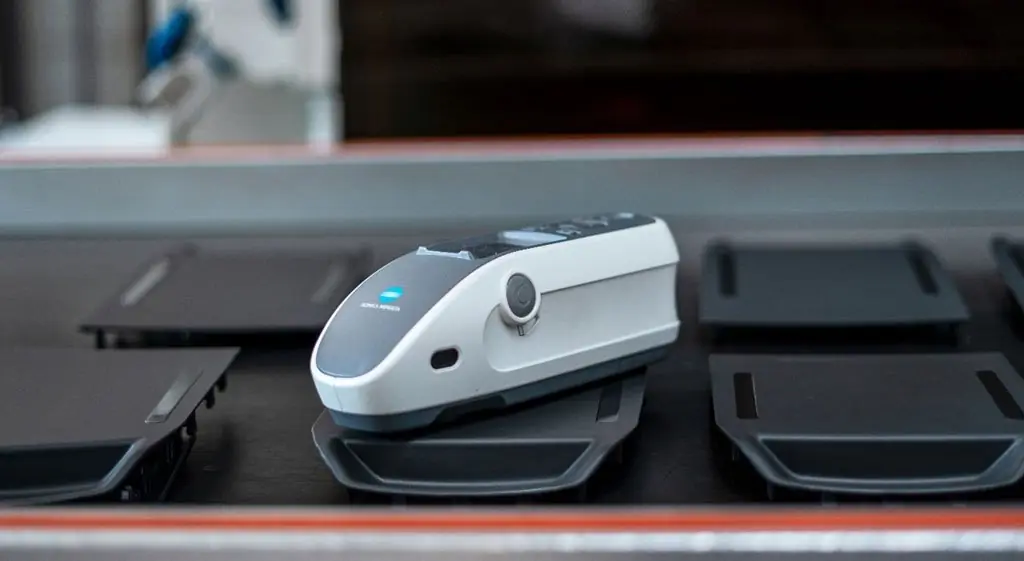
Sample tests can also be run, for example by molding plaques or test specimens for mechanical testing and to assess the appearance of the material. Color compliance is checked with a spectrophotometer, the instrument that measures the color coordinates and the color difference (ΔE) from the reference sample.
These tests confirm that the material lot is correct and that it performs as expected once molded, so that the quality of the finished part matches what was approved for series production.
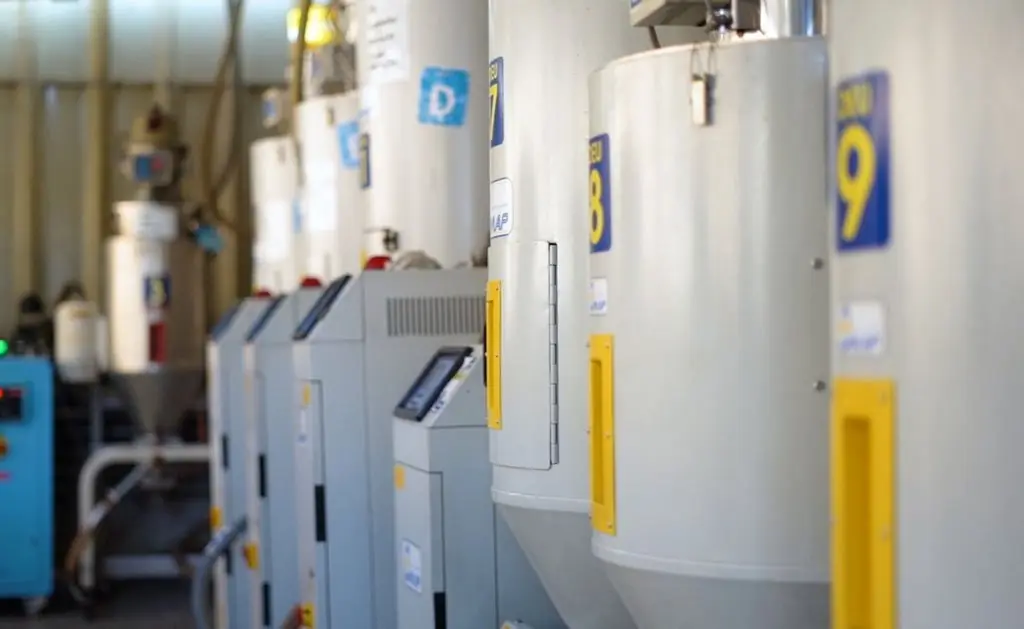
When the material is prepared for production, every resin that requires it must be properly dried, especially hygroscopic polymers such as polyamides (nylon). Drying time and temperature are usually given on the material datasheet.
At Bemar Plast every molding line has its own dryer, with molecular-sieve units (both wheel and twin-tower types) that are checked and serviced at regular intervals.
Process control
Monitoring every stage of the injection molding process is essential to ensure process quality. These are some of the parameters that can be monitored and adjusted to improve the quality of the molded part:
Mold, plasticizing and molding
- melt temperature
- residence time of the material in the barrel
- screw speed and back pressure
- mold temperature
- barrel heating zone temperature profile
- injection, hold and cavity pressure
- mold surface finish
- injection speed, stroke and time
- overall cycle time
- part cooling time.
On each of our lines a dedicated temperature control unit manages the mold temperature. Eleven of our thirteen presses use a Hybrid Energy System, with an average drift of the pressure and flow (P/Q) parameters below 1%: a stable process is the first condition for consistent parts over time.
In-production inspection
Once series production is running, sample inspections are carried out on the molded parts at defined intervals and at specific points in the process, as well as targeted checks if issues arise during molding.
It is essential to check the technical, mechanical and cosmetic characteristics of the parts, for example:
- dimensional stability
- color values
- color consistency
- gloss level
- any cosmetic defects arising during molding.
Dimensional stability is generally very important and becomes critical for parts that belong to an assembly. They have tolerances that are defined and agreed during part and mold design. At Bemar Plast dimensions are measured with a KEYENCE IM-X1000 image-based measuring system, which measures automatically from the drawing or CAD data and returns an OK/NG result with an inspection report.
Color: there are several ways to produce a colored part. You can use precolored compounds, blend the natural resin with a masterbatch at the press, or paint the molded part.
The color must fall within a well-defined shade range, and it must be consistent across all parts, with no significant variation in tone. We check this with a spectrophotometer and a colorimeter.
Gloss is another important parameter to monitor, because a change in gloss alters the visual appearance of the part and therefore its perceived quality. A part that is too shiny in the wrong places can look cheap; equally, a part that is too matte in the wrong places may fail to show off its visible surfaces.
Final inspection
Once production is complete, a series of final checks on the lot is carried out before delivery:
- further visual and cosmetic inspection, both with the naked eye and with dedicated instruments
- checks on packaging and carton labeling, which protect the parts in transit and ensure traceability of the order and the raw material
- verification of critical dimensions and mechanical strength.
Finally, it can be useful, and is sometimes required by the customer specification, to supply an inspection report with each production lot.
Injection molding quality control: conclusions
As this overview shows, quality control in injection molding is a broad and complex subject. Quality touches every aspect of the process, from the raw material to the shipped lot, and in this article we have outlined the main features of how it is managed.
If you need to industrialize a technical part and want to know how we would inspect it, take a look at our plastic injection molding service and send us your drawing.
Frequently asked questions
What is checked in injection molding quality control?
Quality control covers the raw material, the process parameters, series production and the finished lot. On the parts themselves the main checks are dimensions and tolerances, color, gloss and cosmetic defects, as defined in the part's control plan.
What is a control plan?
A control plan is the document that defines, for each part, which characteristics to check, with which instrument, how often and against which acceptance criteria. It is based on the drawing, the tolerances agreed with the customer and the standards of the end-use industry.
Why do some resins need drying before molding?
Hygroscopic polymers such as polyamides (nylon) absorb moisture, which causes splay and bubbles during molding and can degrade the polymer, reducing its mechanical properties. Drying time and temperature are given on the material datasheet; at Bemar Plast every molding line has its own dryer.
How is the color of a molded part checked?
Color is measured with a spectrophotometer, which reads the color coordinates of the part and the color difference (ΔE) from an approved reference sample. The allowed tolerance is agreed with the customer, and visual inspection complements the measurement.
What inspection equipment does Bemar Plast use?
Bemar Plast works under an ISO 9001:2015 quality management system certified by IMQ since 2013. Dimensions are measured with a KEYENCE IM-X1000 image-based measuring system, which gives an OK/NG result and an inspection report; color and appearance are checked with a spectrophotometer and a colorimeter.