

Polyamide (PA), widely known by the trade name nylon, is a semi-crystalline engineering thermoplastic and one of the most used materials for technical parts: gears, bushings, connectors, housings and under-the-hood components. It combines mechanical strength, toughness and resistance to wear, oils and fuels; its main limitation is moisture absorption, which changes dimensions and stiffness and means the pellets must be dried before molding. In injection molding the most common grades are PA6 and PA66, often glass-fiber reinforced.
History
Polyamide 66 was first synthesized in 1935 at DuPont in the United States by the research group led by Wallace Carothers, and it reached the market in 1938 under the name nylon. In the same year, in Germany, Paul Schlack produced PA6 from caprolactam. Nylon changed the textile industry first, then became a core material for engineering parts. This guide looks at the properties of PA with a focus on injection molding.
Types of polyamide
Polyamide is a semi-crystalline thermoplastic whose chain contains the amide group CO−NH. It is used mainly for engineering components, which places it among the engineering polymers, and it is one of the most widely used of them.
The two main types are PA6 and PA66. By changing the chemical structure, many other polyamide families can be obtained, from fully aliphatic to fully aromatic. A non-exhaustive list:
Homopolymers
- PA6
- PA66
- PA7
- PA8
- PA9
- PA11
- PA12
- PA46
- PA69
- PA610
- PA612
- PA613
- PA1313
Copolymers
- PA66/6
- PA6/12
- PA66/6/610
Unmodified polyamides differ only slightly from one another. The grades most used in injection molding are PA6, PA66, PA46 and PA12, together with PA/PP and PA/ABS blends.
| Indicative comparison | PA6 | PA66 |
|---|---|---|
| Melting temperature | about 220 °C | about 260 °C |
| Stiffness and heat resistance | good | higher |
| Toughness | higher | good |
| Moisture absorption | slightly higher | slightly lower |
| Processing | wider processing window | needs higher temperatures |
Values are indicative for unfilled grades: for design work, refer to the resin supplier's datasheet.
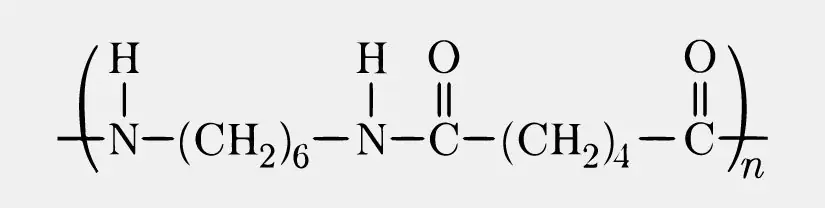
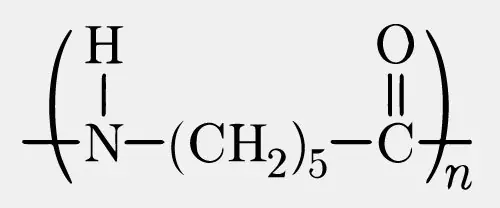
Polyamide (PA) properties: advantages
- Good balance between cost and performance
- High mechanical strength and stiffness
- Good resistance to abrasion, wear, fatigue and aging
- Good sliding properties: suitable for moving parts such as gears, bushings and guides
- Functional toughness at both relatively high and low temperatures
- Once it has absorbed moisture (conditioned), it becomes tougher and more impact resistant
- Chemical resistance to oils, greases, gasoline and other fuels, many solvents including ketones, and dilute alkaline solutions; in the dry state it is a good barrier to oxygen and aromas
- Low melt viscosity, which makes it easier to fill molds, including thin walls
- Good dielectric properties in the dry state
- Can be welded (for example by ultrasonic welding) and bonded with suitable adhesives, such as cyanoacrylates
- Many unfilled grades reach UL 94 V-2 even without flame retardants.
Polyamide (PA) properties: disadvantages
- Absorbs moisture: dimensions, stiffness and electrical properties differ between the dry-as-molded and conditioned states, which has to be accounted for in design
- Unreinforced grades have a relatively low heat deflection temperature: under continuous load at elevated temperature the part tends to creep, while without load it withstands short exposures to temperatures closer to the melting point. Reinforcements and fillers improve this behavior
- Higher water vapor permeability than polyolefins; the gas barrier effect decreases as moisture content rises
- Not resistant to mineral acids and concentrated alkaline solutions, phenols and chloroform; for contact with hot glycol, hydrolysis-stabilized grades are needed
- Stabilization is required for long-term use above 100 °C or outdoors
- Glass-fiber reinforced polyamide is less weather resistant: over the years the surface can erode
- Limited fire performance without flame retardants: glass-filled grades without additives are often rated UL 94 HB
- The low melt viscosity requires molds with accurate shut-offs to avoid flash
- Shrinkage is high and, in glass-filled grades, differs between flow and cross-flow direction, with a risk of warpage
- Thick-walled parts tend to form shrinkage voids.
Polyamide (PA) processing technologies
- Additive manufacturing
- Extrusion
- Fiber spinning
- Blow molding
- Injection molding
- Rotational molding
In injection molding, part quality depends mainly on pellet drying, mold temperature, and the design of wall thicknesses and gate locations.
Moisture absorption and drying before molding
Polyamides are hygroscopic: they absorb water from the surrounding air. For an unfilled PA6 or PA66 at 23 °C and 50 % relative humidity, the equilibrium moisture content is in the range of 2.5-3.5 %; when immersed in water it reaches 8-10 %. As it absorbs water the material swells, becomes tougher and more resistant to abrasion and impact, while its modulus of elasticity decreases.
For molding, what matters is the moisture in the pellets. Wet pellets degrade in the melt (hydrolysis): the result is splay on the surface, lower toughness, and reduced dielectric and mechanical properties in the finished part. Pellets must therefore be dried to the moisture content specified by the resin supplier, typically no more than 0.2 %.
At Bemar Plast every molding line has its own dehumidifying dryer, using molecular sieve desiccant in wheel or twin-tower units that are checked and serviced at regular intervals. Parts come out of the mold dry: stiffer, but less tough than they will be once they reach equilibrium with the environment.
Additives, fillers, colorants and reinforcements
Colorants
Polyamide is colored with pigments or masterbatches that are stable at its processing temperatures. Some organic pigments can degrade or change the part's shrinkage, so the color has to be validated together with the material grade.
Reinforcements, mineral fillers, impact modifiers and flame retardants
Reinforcements and additives are essential for technical polyamide parts.
- Glass and carbon fibers increase modulus, strength and heat deflection temperature, limiting softening at high temperatures.
- Silica, talc, gypsum and glass beads increase part stiffness and reduce shrinkage and warpage.
- Metal powders (such as aluminum or iron) increase heat stability and allow electrically conductive parts.
- Graphite improves sliding behavior and wear resistance.
- Easy-flow injection molding grades are nucleated: they show higher stiffness, lower toughness and lower water absorption.
- Impact modifiers give tougher grades, including at low temperatures.
- Stabilizers protect polyamide against heat, oxygen and UV radiation.
- Flame-retardant formulations are available to reach higher flammability ratings.
When to choose PA and when another material
Polyamide is a frequent choice for mechanical parts exposed to wear, impact and contact with oils and fuels. When high dimensional stability and low water absorption are needed, for example in precision gears, POM (acetal) is worth evaluating. For very high service temperatures and aggressive chemical environments, polymers such as PPS are the next step. For lighter, lower-cost parts with modest mechanical loads, polypropylene (PP) is often sufficient.
Applications of polyamide
- Rail: dampers, fastening and attachment systems
- Air handling: air intake manifolds, fans, impellers
- Covers and fairings
- Intake manifolds for combustion engines
- Pump and motor components
- Carburetor components
- Blow-molded air ducts
- Connectors, such as industrial IEC connectors and terminal blocks
- Engine covers and trims
- Bearings
- Power distribution: low-voltage switchboards
- Electrical and electronics: switches, housings and internal parts for power tools and consumer goods
- Exterior parts: grilles, wheel covers, mirrors
- Automotive: airbag containers, door handles, bumpers
- Membranes and seals
- Furniture: shells, backrests, casters
- Coil formers
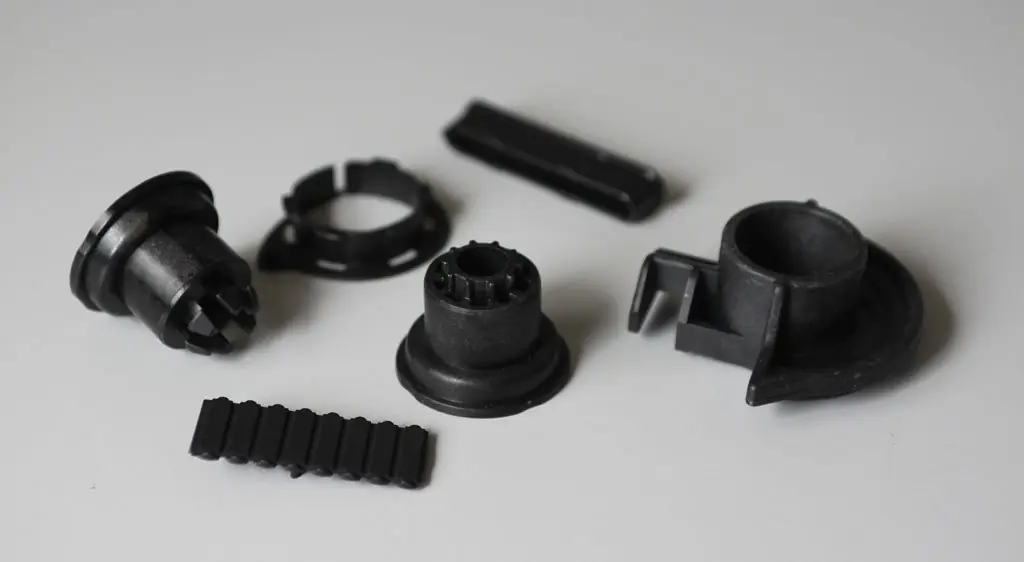
- Structural parts such as screws, gears, sealing rings, bushings, couplings and fittings
- Packaging films
- Rollers
- Trolley wheels and gear wheels
- Power transmission: gears, clutches, chain tensioners
- Sports: ski bindings, ski boots, inline skates
- Shoe soles
- Agriculture: machinery parts (for example brush cutters and lawn mowers)
- Offshore pipes.
Bemar Plast injection molds technical parts in PA6, PA66 and glass-filled PA for automotive, electronics, rail, construction and non-implantable medical applications. For other polyamides, we assess the material together with your engineering team. See how we work on our plastic injection molding page.
Frequently asked questions
What is the difference between PA6 and PA66?
PA66 melts at a higher temperature (about 260 °C versus about 220 °C for PA6) and is stiffer and more heat resistant. PA6 is tougher, absorbs slightly more moisture and has a wider processing window. The choice depends on service temperature, loads and the environment the part works in.
Are polyamide and nylon the same material?
Yes: nylon is the name that came with the PA66 developed by DuPont in the 1930s, and today it is used as a synonym for polyamide. Engineers identify each type by PA followed by numbers (PA6, PA66, PA12), which describe the structure of the polymer chain.
Why does nylon have to be dried before injection molding?
Because it is hygroscopic: if wet pellets enter the press, the water degrades the molten polymer (hydrolysis), causing loss of toughness and surface defects such as splay. At Bemar Plast every molding line has its own dehumidifying dryer with molecular sieve desiccant.
Does moisture change the dimensions of nylon parts?
Yes: as it absorbs water, polyamide swells and becomes tougher but less stiff. For tight tolerances, parts are designed for the conditioned state, filled grades are used, or a less hygroscopic material such as POM (acetal) is considered.
Is glass-filled nylon flame retardant?
Not necessarily: without flame retardants, glass-filled polyamides are often rated UL 94 HB. Many unfilled grades reach V-2; a V-0 rating requires flame-retardant grades, to be checked on the resin supplier's datasheet.
Which polyamides does Bemar Plast mold?
Bemar Plast injection molds PA6, PA66 and glass-filled PA for technical parts in automotive, electronics, rail, construction and non-implantable medical applications. Other polyamides, such as PA12 or PA46, we assess together with your engineering team. Details on our plastic injection molding page.