

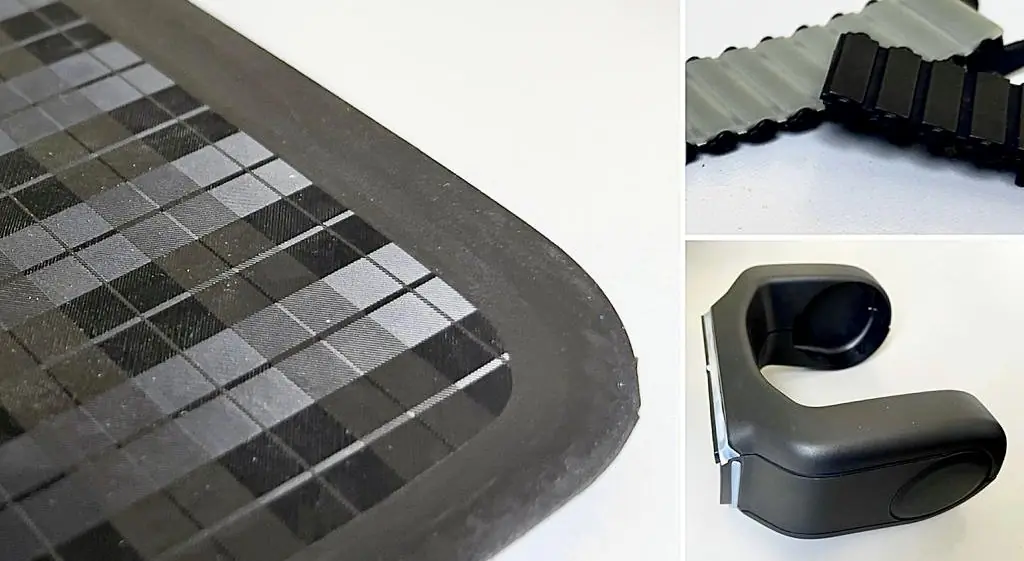
Thermoplastic elastomers (TPE) are materials with the elasticity of rubber that are processed like thermoplastics: they melt, can be injection molded and can be remelted. They are used for seals, soft-touch grips, automotive parts and components overmolded onto a rigid substrate. TPE is not a single material but a family of very different grades (TPS, TPO, TPV, TPU, TPC and TPA), selected by hardness, service temperature, chemical environment and the substrate they are molded onto.
What thermoplastic elastomers are
Thermoplastic elastomers, usually abbreviated to TPE and also known as thermoplastic rubbers, are a broad and varied family of materials. In general, TPEs have the elastic behavior of crosslinked elastomers (natural or vulcanized rubber), with the difference that they can be processed like thermoplastics.
The reason is their structure: a TPE consists of a hard phase, which acts as a physical network, and a soft phase, which provides elasticity. The physical network softens when heated and re-forms on cooling, whereas in vulcanized rubber the links between chains are chemical and permanent. The first styrenic block copolymers were commercialized in the mid-1960s, followed by copolyesters and thermoplastic vulcanizates in the 1970s and 1980s. Since then, TPEs have replaced vulcanized rubber in many applications, as rubber is slower to process and cannot be remelted.
This guide covers the properties of thermoplastic elastomers for injection molding and the industries where they are used.
TPE: a wide range of thermoplastic rubbers
There are many types of TPE. They can be used neat or compounded in different formulations: blended with each other, with rigid thermoplastics, or with oils, fillers, stabilizers, colorants and other additives.
This variety gives a very wide range of thermoplastic elastomers, which ISO 18064 groups into the following families:
- olefinic thermoplastic elastomers, TPO (or TPE-O): blends of polypropylene with ethylene-propylene rubber (EPR or EPDM), uncrosslinked or lightly crosslinked.
- styrenic thermoplastic elastomers, TPS (or TPE-S): block copolymers with hard polystyrene end blocks and an elastic mid-block. In SBS the mid-block is butadiene; in SEBS and SEPS it is hydrogenated (ethylene-butylene or ethylene-propylene), which makes it more stable. They are often compounded with PP and oil.
- thermoplastic vulcanizates, TPV (or TPE-V): a thermoplastic matrix, usually PP, containing rubber particles, usually EPDM, that are crosslinked during mixing (dynamic vulcanization).
- thermoplastic polyurethanes, TPU (or TPE-U): block copolymers with hard urethane segments and soft polyester or polyether segments.
- thermoplastic polyamide elastomers, TPA (or TPE-A): hard polyamide blocks and soft polyether and/or polyester blocks.
- thermoplastic copolyester elastomers, TPC (or TPE-E, COPE): block copolymers with hard semi-crystalline PBT segments and soft polyether or aliphatic polyester segments. The range goes from rubbery grades to flexible engineering materials.
Each family has very different properties, so it makes sense to review the pros and cons of TPE for injection molding while keeping this broad classification in mind.
Thermoplastic elastomers vs vulcanized (thermoset) rubber
TPEs spread when industry needed to replace vulcanized rubber wherever possible. Demand for rubber-like parts was growing, especially in automotive, but vulcanized (thermoset) rubber requires long curing cycles and its scrap cannot be remelted. What was needed was a material that behaves like rubber but is easier to process.
A TPE provides the key property of rubber, elastic behavior: it deforms under load and returns to its original shape when the load is removed. Compared with vulcanized rubber, the advantages of thermoplastic elastomers are many: processing on standard thermoplastic injection molding machines, shorter cycles, regrind of production scrap, overmolding onto other thermoplastics, weldability and easy coloring.
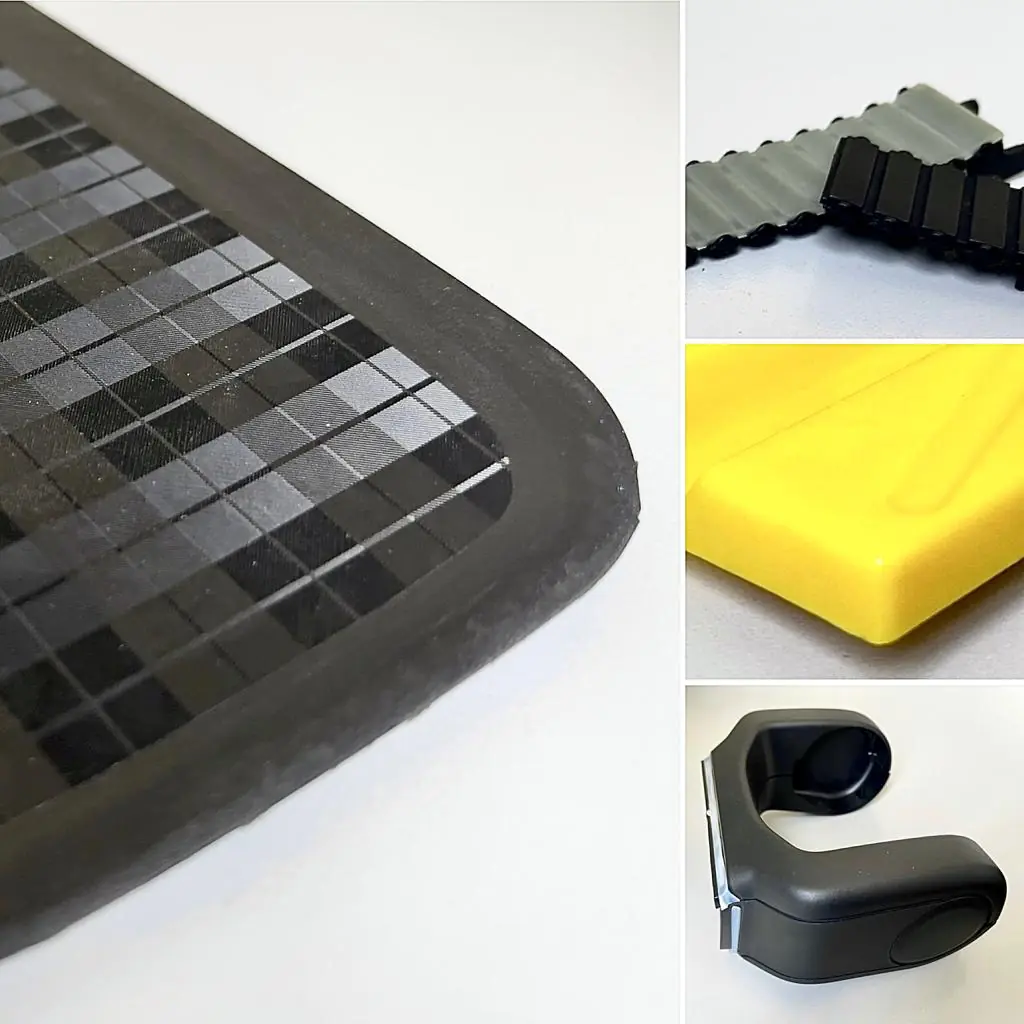
Properties of thermoplastic elastomers: the pros
In general, the main advantages of TPE are:
- easier processing than vulcanized rubber
- lower processing energy than thermosets, thanks to shorter cycles and no curing step
- they can be overmolded onto many thermoplastics, with good adhesion when the material pair is chosen correctly
- good resistance to weathering and ozone in the saturated families (TPO, TPV, SEBS)
- good electrical insulation, especially TPS, TPO and TPV
- good elastic behavior at low temperatures
- easy coloring in the mass
- high softness and resilience, with a wide choice of hardness levels.
Properties by family
Looking at the individual TPE families:
- TPA resists oils, fuels, low temperatures and impact, and offers high flexibility and resilience.
- TPO resists aging, weathering and ozone better than many vulcanized rubbers. Thermoplastic polyolefins also offer good chemical and impact resistance, a good surface appearance and good UV stability; food contact grades are available.
- TPS replaces vulcanized rubber well in many applications and, with the right grades, bonds to several plastics such as PP, PE, PS, ABS, PC and PA. SBS offers good elasticity, easy coloring and good tactile and aesthetic quality; it is easy to process and suitable for overmolding. SEBS keeps its elasticity over a wider temperature range, has better UV, oxidation and aging resistance, and is the reference material for soft-touch applications and two-shot molding; it is available in a wide range of hardness levels.
- TPU offers high wear and abrasion resistance, as well as resistance to oils, greases and fuels. Thermoplastic polyurethane retains flexibility and elastic recovery at low temperatures and gives a high-quality appearance. Aliphatic TPUs resist UV light without yellowing.
- TPV offers elasticity, good recovery after compression, and resistance to aging, ozone and fatigue. It resists dilute acids and bases and water; grades with improved oil resistance and foamable grades are available. It provides good electrical insulation and can be recycled like a thermoplastic.
Properties of thermoplastic elastomers: the cons
Some drawbacks are shared by all thermoplastic elastomers. Compared with thermoset rubber, TPEs generally have lower heat resistance, in some cases lower chemical resistance, and a higher compression set, i.e. more permanent deformation after a sustained compressive load, especially at elevated temperature.
Limitations
The main limitations of each TPE group are:
- TPO has low surface energy, so painting and bonding require surface treatment; its performance drops at elevated temperatures and it is less stiff than standard PP.
- TPA is sensitive to thermo-oxidation and to some organic solvents; it is hygroscopic and must be dried before molding.
- within TPS, SBS has poor resistance to heat, UV and ozone and is sensitive to oils, greases and hydrocarbons. SEBS overcomes most of these limitations, at a higher cost.
- standard EPDM/PP TPV grades swell in contact with mineral oils and hydrocarbons; light-colored grades need UV stabilizers.
- TPU is hygroscopic and requires careful drying; polyester-based grades are sensitive to hydrolysis, and TPU is attacked by polar solvents and strong acids and bases. Aromatic TPUs tend to yellow in light. The cost/performance ratio has to be assessed case by case.
Processing methods
- Injection molding and overmolding
- extrusion and coextrusion
- thermoforming
- film production
- blow molding.
Guidelines for injection molding TPE
Points to consider when designing the part and the mold:
- drying: TPU, TPC and TPA must always be dried; for the other families follow the grade datasheet. Residual moisture causes surface defects and, in hygroscopic grades, degradation.
- adhesion in overmolding: the TPE grade depends on the rigid substrate. A standard TPS or TPO bonds well to PP; ABS, PC and PA need modified grades; TPU bonds well to PC and ABS. Substrate temperature at the moment of injection also affects bond strength.
- mechanical interlocks: through-holes, undercuts and ribs in the rigid part improve retention when chemical adhesion is not enough or the material pair is not compatible.
- mold: TPEs flow very easily in the melt and tend to flash, so they need accurate shut-offs and carefully sized vents. Soft parts deform during ejection: large-area ejectors and, where needed, air ejection are preferred.
- shrinkage: varies with family, hardness and flow direction; the starting point is the material supplier's datasheet.
Applications
Thermoplastic elastomers are used in a wide variety of industries and products, given their broad range of properties. TPEs are widely used in multi-shot molding and overmolding, in any product that needs comfort and a secure grip.
For an overview of the parts that can be made from TPE, here is a short (non-exhaustive) list covering all the families above:
- automotive: window seals, floor mats, airbag doors, instrument panel skins, air intake ducts, armrests and storage compartments
- cable jacketing
- sports equipment, for example swim fins, masks and ski boot components
- roofing membranes
- toys
- knobs, buttons and seals
- grips and handles, for example on scissors, knives, screwdrivers and tools in general, toothbrushes and razors
- electrical and electronics: plugs, sealing rings, sockets and cable jacketing
- medical: components for non-implantable medical applications, such as grips and soft parts of devices.
TPEs are often combined with a rigid substrate: for the most common ones, see our guides to PP (polypropylene), ABS and PA (polyamide, nylon).
Conclusions
TPEs are available in a wide range of grades and are used in very different applications. Choosing a grade starts with a few questions: required hardness, service temperature, contact with oils or chemicals, UV exposure and, for overmolding, the substrate material.
At Bemar Plast we mold TPE at our plant in San Giovanni Ilarione (Verona, Italy), both all-TPE parts and components overmolded onto a rigid substrate, including two-shot (2K) molding on rotary-table presses. Every molding line has a dehumidifying dryer for hygroscopic materials. For the medical sector we make components for non-implantable medical applications; production takes place in a controlled industrial environment, not in a cleanroom. We work with your engineering team to select the right TPE for the part: details are on our plastic injection molding page.
Frequently asked questions
What is a TPE?
A TPE (thermoplastic elastomer) is a material that behaves like rubber but processes like a thermoplastic: it melts when heated and is injection molded without vulcanization. The term covers a broad family that includes TPS, TPO, TPV, TPU, TPC and TPA.
What is the difference between TPE and vulcanized rubber?
The difference lies in how the polymer chains are linked: in vulcanized rubber the crosslinks are permanent chemical bonds, while in a TPE they are physical links that soften when heated and re-form on cooling. That is why a TPE can be remelted, overmolded and molded in shorter cycles, while vulcanized rubber usually offers better heat resistance and lower compression set.
Are TPE and TPU the same thing?
No: TPU is one of the TPE families. It stands out for abrasion and oil resistance, but it is hygroscopic, must be dried before molding, and polyester-based grades are sensitive to hydrolysis.
Does TPE need to be dried before injection molding?
It depends on the family: TPU, TPC and TPA are hygroscopic and must always be dried, while for TPS, TPO and TPV you follow the grade datasheet. Residual moisture causes surface defects and, in hygroscopic grades, a loss of mechanical properties.
Which plastics can TPE be overmolded onto?
Bond strength depends on the material pair: standard TPS and TPO grades bond well to PP, while ABS, PC and PA need grades modified for that substrate; TPU bonds well to PC and ABS. When chemical adhesion is not enough, mechanical interlocks are designed into the rigid part.
Does Bemar Plast mold TPE parts?
Yes: we injection mold TPE in Italy, both all-TPE parts and overmolded components, including two-shot (2K) molding on rotary-table presses. See our plastic injection molding service.