

PA6 (polyamide 6, also known as nylon 6) is a semi-crystalline engineering plastic made by polymerizing caprolactam. It combines toughness, wear resistance and good sliding properties with easy processing, which makes it one of the most widely used engineering resins for injection molded gears, clips, connectors and structural parts. Its main limitation is moisture absorption, which has to be managed both in molding and in part design.
History
PA6 was first synthesized in 1938 by Paul Schlack, a chemist at IG Farben, who set out to obtain a material similar to the PA66 developed by DuPont in the United States without infringing its patents. Instead of reacting a diamine with a diacid, as for PA66, Schlack used ring-opening polymerization of caprolactam. In Germany the material was sold under the name Perlon, initially for textile fibers; today it is also used for films, stock shapes and, above all, injection molded parts.
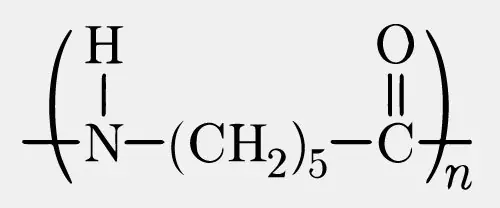
The number 6 refers to the six carbon atoms in the repeating unit, which comes from a single monomer. In PA66 the two numbers refer to the carbon atoms of the starting diamine and diacid. For an overview of the whole family, see our guide to PA – polyamide (nylon).
Structure and grades
PA6 is a semi-crystalline aliphatic polyamide. The amide groups (–CO–NH–) in the chain form hydrogen bonds between molecules: they give the material its strength and toughness, and also its tendency to absorb water from the environment.
Injection molders rarely use neat PA6: resin suppliers offer a wide range of compounds.
- Unfilled: tough, with good sliding properties, for clips, cable ties, bushings and impact-loaded parts.
- Glass-filled: glass fiber, usually from 15% to 50%, increases stiffness, strength and heat resistance. This is the most common grade for structural parts and metal replacement.
- Mineral-filled or glass bead-filled: stiffer than unfilled PA6, with more uniform shrinkage and less warpage than glass fiber grades.
- Impact-modified: with elastomers that improve impact strength at low temperatures and in the dry-as-molded state.
- Flame-retardant: for electrical and electronic applications.
- Heat- or UV-stabilized: for long-term service at high temperatures or outdoors.
- Lubricated: with additives such as graphite, molybdenum disulfide or PTFE to reduce friction and wear.
PA6 vs PA66
| Property | PA6 | PA66 |
|---|---|---|
| Melting point | about 220 °C | about 260 °C |
| Heat resistance | good | higher |
| Moisture absorption | slightly higher | slightly lower |
| Processing window | wider | narrower |
| Surface of glass-filled grades | usually more even | fibers more visible under the same conditions |
PA6 properties: advantages
- High toughness and impact strength, especially once conditioned to moisture equilibrium.
- Good abrasion, wear and fatigue resistance with a low coefficient of friction, well suited to gears, bushings, rollers and slides.
- Resistance to oils, greases, fuels and many organic solvents.
- High stiffness and strength in glass-filled grades, which retain good performance at temperatures close to the melting point.
- Good electrical insulation in the dry state.
- Very low melt viscosity, suited to thin walls and long flow paths.
- Good surface finish, including reinforced grades.
- Recyclability: scrap can be reground and, at industrial scale, PA6 can also be depolymerized to recover caprolactam.
PA6 properties: disadvantages
- It is hygroscopic: as it absorbs water it swells, loses stiffness and strength and its electrical properties change. Parts must be designed for the conditioned state, not only for the dry-as-molded values on data sheets.
- Lower heat resistance than PA66 and semi-aromatic polyamides such as PPA.
- Poor resistance to strong mineral acids, oxidizing agents and phenols. It is prone to stress cracking in contact with some salt solutions, such as zinc chloride.
- Without stabilizers it degrades outdoors under UV light and ages with prolonged exposure to high temperatures.
- The most demanding flammability ratings require flame-retardant grades.
- In glass-filled grades shrinkage differs along and across the flow direction: without proper part and mold design the part warps.
- Thick sections are prone to sink marks and internal voids.
Processing and injection molding
PA6 is processed by injection molding, extrusion (films, tubes, profiles and stock shapes) and fiber spinning; monomer casting produces large cast nylon stock shapes. In injection molding, these are the points that matter most.
- Drying: pellets must be dried in a desiccant dryer, typically at about 80 °C for a few hours, down to the residual moisture specified by the supplier. Drying time depends on the initial moisture content and on the dew point of the air. Wet resin causes splay and bubbles and degrades the polymer; drying for too long can change melt viscosity.
- Temperatures: melt temperature is typically between 240 and 290 °C, higher for glass-filled grades. Mold temperature is typically between 40 and 90 °C: a hotter mold promotes crystallization, dimensional stability and surface quality. The correct values are those in the processing data sheet of the selected grade.
- Residence time: keep it short to avoid thermal degradation of the melt in the barrel.
- Mold: the very fluid melt needs tight shut-offs to prevent flash; venting, gate locations and wall thicknesses must be designed to limit warpage and sink marks, especially with glass fiber.
- Conditioning: parts come out of the mold dry and relatively brittle. When toughness and stable dimensions are needed right away, parts are conditioned in water or humid air until they reach equilibrium.
In our molding shop every line has a desiccant dryer, with molecular sieve dryers of the rotary wheel or twin-tower type, and a mold temperature controller. Learn more about our plastic injection molding service: together with your engineering team we select the most suitable PA6 grade for the part, or an alternative such as POM when dimensional stability in humid environments is the priority.
PA6 applications
- Automotive: engine covers, under-the-hood parts in heat-stabilized glass-filled PA6, clips and fasteners, handles, seat components and housings.
- Electrical and electronics: connectors, terminal blocks, switch components, power tool housings.
- Mechanical engineering: gears, bushings, plain bearings, rollers, wheels and slides.
- Building and installation: wall plugs, fasteners, fittings and technical components.
- Railway: fasteners and technical components.
- Furniture: chair bases and mechanisms, casters, structural components.
- Packaging and textiles: films with good oxygen barrier for food packaging, fibers and yarns.
Frequently asked questions
What is the difference between PA6 and PA66?
PA6 melts at around 220 °C and PA66 at around 260 °C: PA66 handles heat better and absorbs slightly less moisture, while PA6 has a wider processing window and glass-filled PA6 grades usually give a more even surface. For many technical parts the two are interchangeable; the choice depends on service temperature, required stiffness and appearance.
Does PA6 need to be dried before injection molding?
Yes: PA6 pellets must be dried in a desiccant dryer, typically at about 80 °C for a few hours, down to the residual moisture specified in the resin supplier's processing data sheet. Wet resin causes splay, bubbles and loss of mechanical properties; overdrying can change melt viscosity.
How much moisture does PA6 absorb?
Unfilled PA6 absorbs about 3% water at equilibrium with an environment at 23 °C and 50% relative humidity, and about 9% when saturated in water. Absorbed water increases toughness and part dimensions and reduces stiffness and strength; glass fiber reduces these effects.
When should you use glass-filled PA6?
Glass-filled PA6 is the right choice when a part needs more stiffness, strength and dimensional stability under heat than the base resin offers, for example brackets, structural housings and metal replacement parts. The trade-off is anisotropic shrinkage, which leads to warpage if the part and mold design do not account for it.
Does Bemar Plast mold PA6?
Yes: we mold unfilled and glass-filled PA6 on our 13 injection molding lines, all equipped with a desiccant dryer. See our plastic injection molding service.