

ABS (acrylonitrile butadiene styrene) is an amorphous thermoplastic that combines impact strength, stiffness and good surface quality. It is easy to injection mold, can be painted and chrome plated, and is used for housings, enclosures and cosmetic parts in automotive, electronics, household appliances and consumer products. Its main limitations are moderate heat and UV resistance and sensitivity to solvents such as ketones and esters.
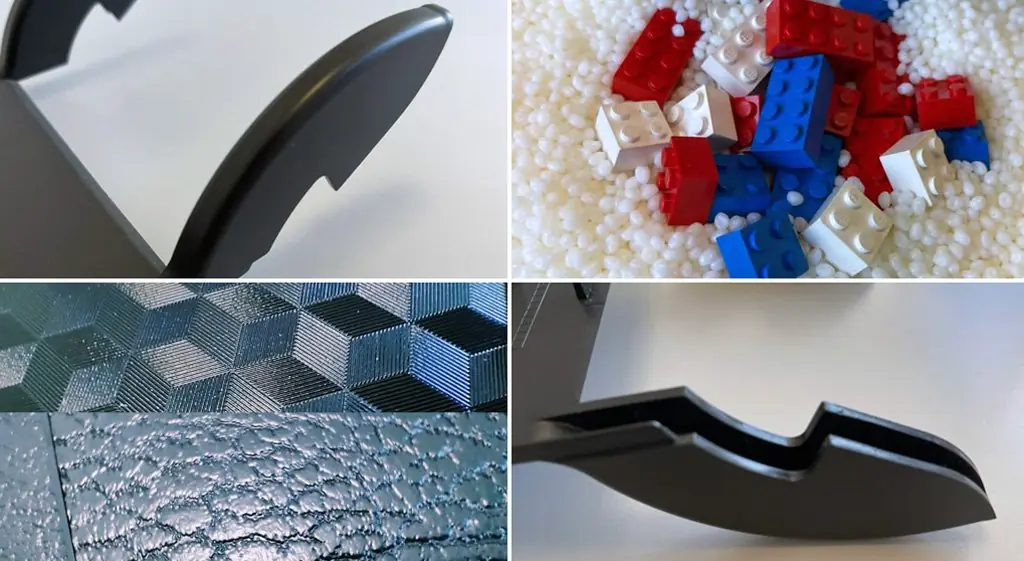
ABS is also known as the material of LEGO bricks, which have been made from ABS since 1963, but its use extends to many other industries, from automotive to consumer goods.
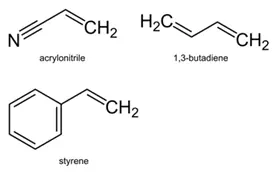
ABS is made from three monomers – acrylonitrile, butadiene and styrene – each contributing different properties.
Acrylonitrile provides hardness, stiffness, and chemical and heat resistance; styrene makes ABS easy to process and gives it gloss; butadiene adds toughness and impact resistance. Changing the ratio of the three monomers changes the properties of the material, so ABS can be tailored to the part being produced.
Natural ABS is opaque, ivory to slightly yellowish in color; transparent grades (MABS) are also available, obtained by modifying the formulation with acrylic monomers.
Below we cover the advantages and limitations of ABS, followed by an overview of processing methods and the industries where it is used.
ABS properties: advantages
- Good processability
- Good chemical resistance to aqueous acids and alkalis, concentrated hydrochloric and phosphoric acids, alcohols, and animal, vegetable and mineral oils
- Good dimensional stability: like other amorphous polymers, it has low, uniform shrinkage and a limited tendency to warp
- Retains good toughness at low temperatures (behavior varies by grade)
- Good mechanical properties: ABS is tough, stiff and impact resistant
- Good electrical insulator
- High-quality appearance: smooth, glossy surface, easy to color
- One of the most widely used plastics for chrome electroplating, and well suited to painting and pad printing
- Faithfully reproduces mold textures and surface finishes
- In-house regrind (runners and rejects) can be blended with virgin resin, at ratios that depend on the grade and the customer's requirements
- Heat-resistant, transparent, flame-retardant and high-impact grades are available.
ABS properties: limitations
- Slightly hygroscopic: it must be dried before processing
- Limited fatigue resistance
- UV exposure causes yellowing and loss of mechanical properties unless the material is stabilized or painted
- Limited weatherability: outdoor parts use stabilized grades or materials such as ASA
- Moderate heat resistance: higher service temperatures call for heat-resistant grades or PC/ABS blends
- Not resistant to ketones, esters, ethers, aromatic and chlorinated hydrocarbons, or concentrated oxidizing acids such as sulfuric and nitric acid
- Flammable unless flame-retardant additives are used; flame-retardant grades with UL 94 ratings are available
- Produces dense smoke and toxic gases when burning
- For high-voltage insulation or tracking resistance (CTI) requirements, check the data for the specific grade
- Food contact and medical applications require dedicated grades, compliant with the applicable regulations and documented by the resin supplier.
Processing methods
ABS can be processed by:
- Injection molding, including two-shot molding and overmolding with thermoplastic elastomers (TPE)
- Extrusion and thermoforming
- Additive manufacturing (FDM 3D printing).
In injection molding, ABS has a wide processing window. Typical guidelines, always to be confirmed on the grade's datasheet, are: drying at 80-90 °C for at least 2 hours, melt temperature of roughly 210-260 °C and mold temperature of roughly 25-80 °C, toward the upper end for a higher-gloss surface. For parts that will be chrome plated or painted, clean material, proper drying and a stable process are what matter most.
At Bemar Plast we mold ABS and PC/ABS for technical and cosmetic components: presses, technologies and batch sizes are described on our plastic injection molding page.
Applications
- Automotive: interior trim, armrests, door panels, grilles, mirror housings, pillar trims
- Toys, such as LEGO bricks and toy cars
- Household appliances and electronics: control panels, housings, boxes and electrical components, lamps, computer keyboards and wall sockets
- Consumer product parts, such as phones, protective helmets, TVs, radio equipment, vacuum cleaners, luggage and musical instruments
- Office furniture components.
Conclusions
ABS is a versatile thermoplastic thanks to its balance of mechanical, chemical and aesthetic properties and its ease of processing. It is usually one of the most cost-effective engineering plastics, and a common choice when a part needs impact strength and a good surface finish.
When a part has to work at higher temperatures, outdoors or in contact with solvents, alternatives are worth evaluating: PC/ABS, ASA, or materials with different properties such as PMMA for transparent parts. To choose the right grade for your component, contact our engineering team.
Frequently asked questions
Is ABS an engineering plastic?
ABS is generally classed as an entry-level engineering plastic, on the boundary with commodity polymers. Compared with polystyrene it offers higher toughness and chemical resistance; compared with polycarbonate and polyamides it has lower thermal and mechanical performance, but lower cost and easier processing.
Does ABS need drying before injection molding?
Yes, ABS absorbs a small amount of moisture and must be dried before molding, typically at 80-90 °C for at least 2 hours or as specified on the supplier's datasheet. Wet resin causes splay (silver streaks), bubbles and loss of gloss. At Bemar Plast every molding line has a molecular-sieve dryer.
What temperature can ABS withstand?
Standard ABS is suited to moderate service temperatures: its glass transition is around 100-110 °C, and the maximum service temperature depends on the grade and the load. For higher temperatures, heat-resistant grades or PC/ABS blends are used.
Is ABS UV resistant and suitable for outdoor use?
No, unstabilized ABS yellows and loses toughness under prolonged sunlight. Outdoor parts need UV-stabilized grades, a protective paint finish or materials such as ASA.
Can ABS be used for food contact or medical applications?
Yes, but only with dedicated grades: there are ABS grades compliant with EU Regulation 10/2011 and FDA regulations for food contact, and medical grades with biocompatibility documented by the resin supplier. Bemar Plast molds components for non-implantable medical applications; production takes place in a controlled industrial environment, not in a cleanroom.
What is the difference between ABS and PC/ABS?
PC/ABS is a blend of polycarbonate and ABS with better heat and impact resistance than ABS, while remaining easy to mold. It is chosen for electronic enclosures and more demanding automotive interior parts; Bemar Plast injection molds both ABS and PC/ABS.