

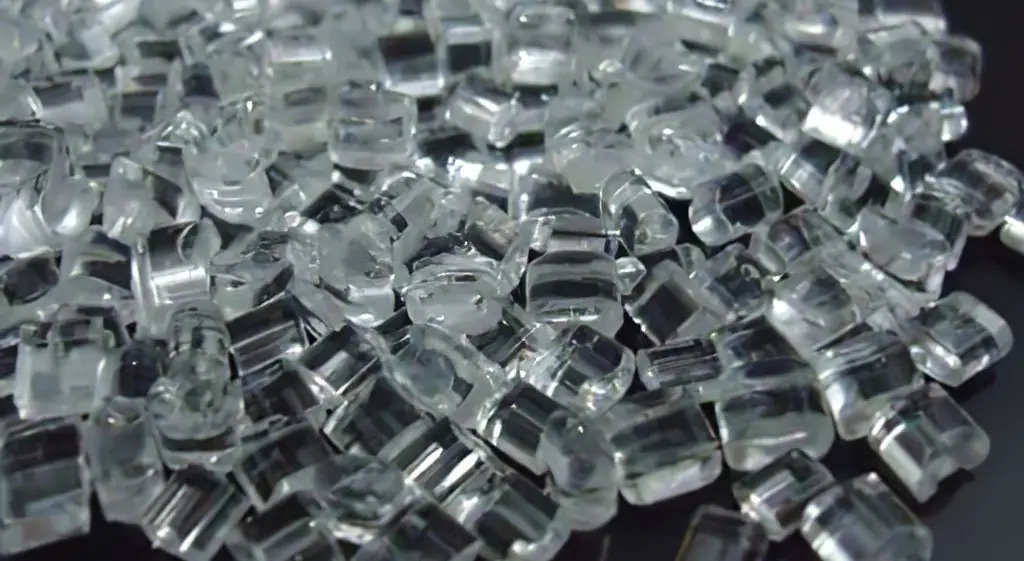
Polymethyl methacrylate (PMMA), commonly called acrylic or acrylic glass, is an amorphous, transparent thermoplastic with high light transmission, a glossy surface and good resistance to UV light and weathering. It is used where clarity and appearance matter: lamp lenses and light guides, display covers, optical components, lighting and cosmetic packaging. Its main limitations are low impact strength and sensitivity to some solvents.
The best-known trade name is Plexiglas, registered as a trademark by Röhm in Germany in 1933. Other widely used trade names are Perspex and Acrylite.
What PMMA is
PMMA has no color of its own: unpigmented, it is clear and colorless, and it can be colored in transparent, translucent or opaque shades. Because it is amorphous, it has no sharp melting point; it softens gradually above its glass transition temperature of about 105 °C (221 °F). In injection molding, typical melt temperatures are roughly 220–260 °C (430–500 °F) with a mold temperature of 50–80 °C (122–176 °F). Exact settings depend on the grade and should be taken from the resin supplier's datasheet.
Standard PMMA covers many applications, and modified grades extend its range: impact-modified grades with an elastomeric phase, grades with higher heat resistance, and styrene copolymers, which cost less but are less transparent.
Advantages of PMMA
- High clarity: light transmission comparable to or slightly higher than ordinary glass.
- Low weight: less than half the density of glass.
- High stiffness and good dimensional stability.
- Very good optical and cosmetic properties, with a high-gloss surface.
- Good tensile and compressive strength.
- Can be colored in any shade.
- Good scratch resistance compared with other transparent thermoplastics such as PC and PS.
- High resistance to UV light and weathering: it yellows little over time and keeps its optical properties outdoors.
- Low moisture absorption, although it still needs drying before injection molding.
- Resistant to water, weak acids, dilute alkalis, oils and greases.
- Dedicated grades are available for cosmetic packaging and medical applications.
Limitations of PMMA
- Lower surface hardness than glass: it scratches more easily, so hard coatings are used where needed.
- Low impact strength in standard grades. For loaded parts, use an impact-modified grade or consider polycarbonate.
- Attracts dust because it builds up static charge.
- Attacked by ketones, esters, and aromatic and chlorinated hydrocarbons. Alcohols and some cleaners can cause environmental stress cracking (ESC) in parts with molded-in stress.
- Limited heat resistance: the service temperature stays well below the glass transition temperature.
- Unmodified PMMA transmits part of the UV spectrum. Where UV must be blocked, grades with UV absorbers are used.
- Flammable: standard grades are not self-extinguishing.
- Fairly high melt viscosity: thin walls or long flow paths call for a higher-flow grade.
- Molded parts can show bubbles, sink marks, weld lines, burn marks, warpage and molded-in stress, and on a clear part these defects stay visible.
- Very small pin gates are not recommended. Generous gates (sprue, fan or edge gates) work better and are then removed with suitable degating methods.
Processing methods
- Injection molding, for technical and cosmetic parts in series production.
- Extrusion of sheet, profiles and tubes.
- Casting, for cast sheet and blocks.
- Thermoforming of sheet.
- Machining and laser cutting of sheet.
Injection molding PMMA: practical guidelines
- Drying: dry the pellets in a desiccant dryer before molding. Residual moisture causes bubbles, silver streaks (splay) and loss of clarity.
- Controlled mold temperature: a stable mold temperature reduces molded-in stress and improves surface gloss.
- Multi-stage injection: graduated injection speed profiles limit jetting, gate blush and orientation stress.
- Part design: keep wall thickness as uniform as possible, use generous radii and avoid sharp corners, which concentrate stress and promote cracking.
- Annealing: for parts exposed to cleaners or solvents, annealing can reduce residual stress.
- Purging: purge the barrel thoroughly at material and color changes, because any contamination shows in a clear part.
In our plant every molding line has a molecular-sieve dryer and a mold temperature controller. Color and appearance are checked with a spectrophotometer and a colorimeter, dimensions with an image-based measuring system.
Applications
- Automotive and road safety: tail lamp lenses, reflectors, light guides, high-gloss trim, display covers.
- Aerospace: aircraft windows and transparent canopies.
- Lighting: diffusers, lenses and light guides, including for LEDs.
- Building and architecture: sheet, glazing, panels, profiles and tubes.
- Electronics: display windows, covers and optical components.
- Eyewear and optics: lenses and optical components.
- Cosmetics: caps, jars and packaging.
- Medical and healthcare: clear parts for diagnostics and laboratory use.
- Aquariums.
- Biomedical: specific grades exist, including for implantable uses; these are outside our production.
Summary
PMMA is chosen when optical properties, appearance and weather resistance matter. Where impact strength is critical, compare it with polycarbonate or an impact-modified grade, or with ABS for parts that do not need to be transparent.
Bemar Plast injection molds PMMA in its plant in San Giovanni Ilarione, near Verona, Italy, under an ISO 9001:2015 certified quality system. We mold with the customer's existing mold or design a new one, built by partner toolmakers in Italy or China, at the customer's choice. For the medical sector we make components for non-implantable medical applications, produced in a controlled industrial environment, not in a cleanroom. To choose the right PMMA grade for your part, contact our engineering team through the plastic injection molding page.
Frequently asked questions
Is PMMA clearer than glass?
Yes, PMMA transmits as much visible light as ordinary glass or slightly more, at less than half the weight. It scratches more easily than glass, so hard coatings are used where abrasion is a concern.
What is the difference between PMMA and polycarbonate (PC)?
PMMA has better scratch and UV resistance, while PC has far higher impact strength and heat resistance. PMMA is the usual choice for cosmetic and optical covers exposed to light; PC for clear parts that must withstand impact or higher temperatures.
Does PMMA need to be dried before injection molding?
Yes, PMMA absorbs little moisture but must be dried before molding, because residual water causes bubbles, splay and loss of clarity. Drying time and temperature depend on the grade and are given on the resin supplier's datasheet.
Which chemicals attack PMMA?
Ketones, esters, and aromatic and chlorinated hydrocarbons attack PMMA. Alcohols and some cleaning agents can cause environmental stress cracking in parts with molded-in stress, so compatibility with cleaners should be checked at the design stage.
Are Plexiglas, Perspex and PMMA the same material?
Yes, Plexiglas, Perspex and Acrylite are trade names for PMMA, commonly called acrylic. Plexiglas was registered as a trademark by Röhm in Germany in 1933.
Does Bemar Plast mold PMMA parts?
Yes, we injection mold PMMA in our plant in San Giovanni Ilarione, near Verona, Italy, using the customer's mold or a new mold designed by us. For the medical sector we make components for non-implantable medical applications, produced in a controlled industrial environment, not in a cleanroom. See our plastic injection molding service.