

Production molds are injection molds built to make the same part in large volumes, over many years, with repeatable dimensions from one shot to the next. Unlike prototypes and pilot tools, which are used to validate the design, they are the final tooling for series production: they cost more up front, but that cost is spread across high volumes and brings down the price of each part.
In industrial manufacturing, and especially in plastic injection molding, production molds are one of the factors that decide quality, efficiency and cost. But what exactly does the term mean, and why are they so central to manufacturers in sectors as different as home and design, automotive, electronics and gardening?
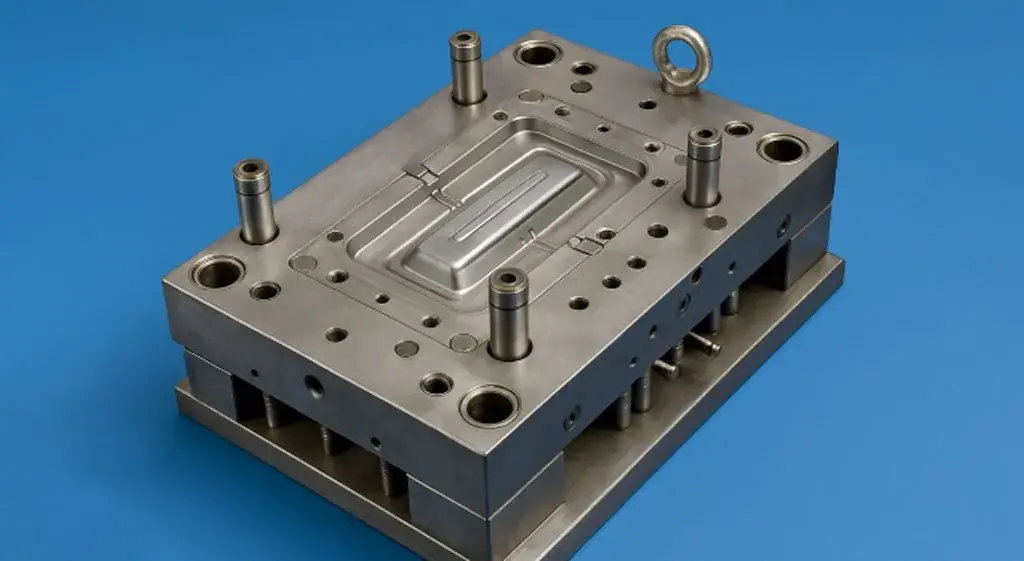
What production molds are
Production molds are tools designed to make parts in large quantities while keeping dimensions, strength and surface finish consistent. Unlike 3D-printed prototypes (FDM, SLA, MJF) or pilot molds, which validate the design in the early stages, production molds are built for continuous manufacturing and for a long service life.
Key features
- Durability: made from hardened or pre-hardened mold steels selected for the polymer being molded, with surface treatments where needed, they are built to withstand a high number of cycles, up to millions for the most robust tools. Glass-filled polymers, such as many polyamides, are abrasive and call for more wear-resistant steels.
- Precision: they hold tight tolerances, which are essential wherever part reliability is critical.
- Repeatability: every part matches the previous one within the design tolerances, a key requirement for companies working to certified quality standards.
- Customization: even as "production" tools, molds are designed around the part and the application, with dedicated cooling channels, ejection systems or metal inserts for overmolding. With co-design, part variants can also be planned from the start using interchangeable inserts, extending the range of geometries without building a completely new mold.
Why a production mold is a strategic investment
A production mold is a significant up-front investment that pays back when the volumes are right:
- Lower unit cost: the more parts you make, the lower the cost per part.
- Shorter cycle times: well-designed cooling and reliable ejection cut cycle time and keep the process stable.
- Consistent quality over time: with scheduled maintenance, shape and dimensions stay within tolerance even after hundreds of thousands of parts.
Where production molds are used
Production molds are used across a wide range of markets:
- Home and design: handles, kitchen and bathroom components.
- Automotive: technical and functional parts that must meet strict safety standards.
- Electronics and electrical equipment: housings and enclosures with tight tolerances.
- Agriculture and gardening: tough, durable components for equipment exposed to wear and the elements.
- Plumbing and hydraulics: fittings, technical components and accessories that must withstand pressure, stay leak-tight over time and perform reliably in continuous use.
Why mold design matters
The quality of a production mold depends largely on its design. Good mold design not only reduces molding defects (sink marks, warpage, flash) but also optimizes material use and cycle time and simplifies secondary operations and assembly.
That is why the mold is designed together with the part: analysis of wall thickness, gate locations and cooling, mold-filling simulations with specialist partners when needed, and continuous dialogue with the customer. This is how a mold becomes a true strategic asset for industrial production, and it is the approach behind our injection mold design service: we design the mold in-house and have it built by qualified toolmakers in Italy or China, as the customer prefers, to our technical specification.
Want to turn your ideas into real products?
Since 1995 Bemar Plast has supported companies with mold design, 3D prototyping and plastic injection molding of technical thermoplastic parts. We also mold with existing tools, whether transferred from another supplier or built on the customer's behalf.
- ISO 9001:2015 certified quality system
- Batches from 1,000 parts (recommended minimum) up to one million parts per year per item
- 13 presses from 10 to 480 t, including two-shot (2K) molding
- 100% renewable electricity, certified with Guarantees of Origin
Contact us for a tailored consultation: call +39 045 6550855 or email info@bemarplast.com.
Frequently asked questions
What is the difference between a production mold and a prototype mold?
A production mold is built for continuous manufacturing, with steels and components sized for a high number of cycles; a prototype or pilot mold validates the design with a limited number of parts, has a shorter life and is often simpler in construction. For form-and-fit checks even earlier, 3D-printed prototypes are used.
How many parts can a production mold make?
It depends on the steel, the polymer and maintenance: a well-designed, well-maintained hardened-steel production mold can run for millions of cycles. Glass-filled polymers are abrasive and call for more wear-resistant steels.
When does a production mold make sense?
When the expected volumes allow the tooling cost to be absorbed into the unit cost of the part. At Bemar Plast the recommended minimum batch is 1,000 parts, with production of up to one million parts per year per item; every project is assessed case by case.
Who owns the production mold?
The mold always belongs to the customer. On request, Bemar Plast stores it in its mold warehouse, treats it with dedicated products and has it looked after by its technicians to extend its service life.
Where are Bemar Plast molds built?
Molds are designed in-house and built by qualified toolmakers in Italy or China, as the customer prefers, to the Bemar Plast technical specification; on request we prepare a dual quote. Design approval, tryout and maintenance stay with us, and parts are molded entirely in Italy, at our plant in San Giovanni Ilarione.