

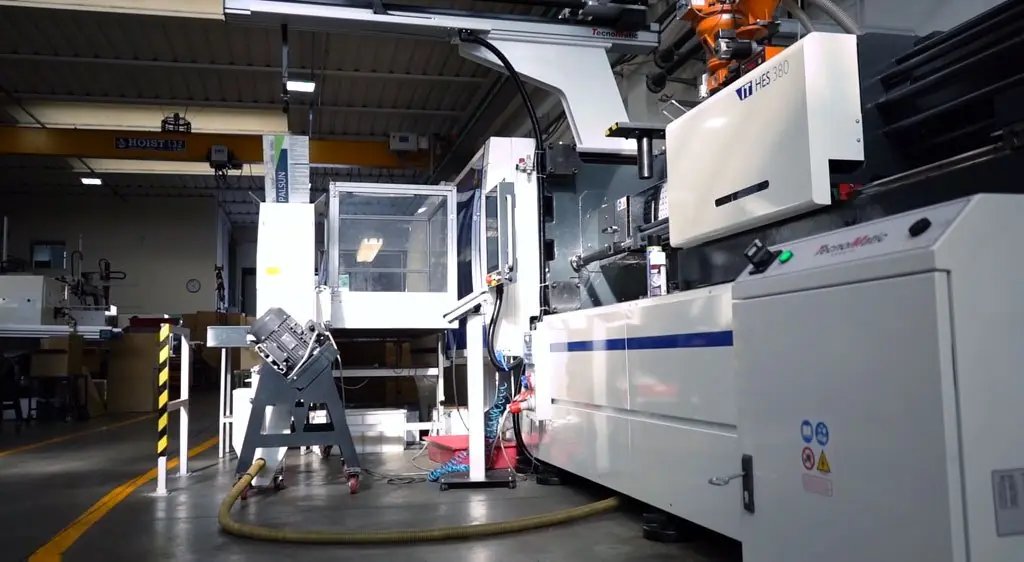
This video shows a new injection molding machine being installed in the Bemar Plast molding shop in San Giovanni Ilarione, near Verona, Italy, and the new production line being brought into service. The machine joined our press fleet in July 2020, the year the company, in business since 1995, turned 25.
In 2020, however, we could not celebrate that anniversary with our partners in person.
So we decided to bring you into our plant, if only virtually, and share a small but important piece of news with you.
In July we gave ourselves a "gift": we added a new machine to our press fleet because, as we never tire of saying, innovation is one of our cornerstones.
To "host" you at our plant, we filmed the work. In the video (in Italian) you will see the installation process of the new production line and its startup.
Special thanks go to the technical team who helped install the equipment.
Our molding shop today
Today the shop runs 13 thermoplastic injection molding lines, with clamping forces from 10 to 480 t. Two machines, fitted with a rotary table and a second injection unit, are dedicated to two-shot (2K) molding; 9 lines are tended by 3-axis electric robots.
Every line has a dryer, a mold temperature controller and a beside-the-press granulator to recover sprues and runners. Eleven of the 13 lines are equipped with a Hybrid Energy System (HES), with measured energy savings of 30 to 75% compared with a conventional setup.
On these lines we mold technical components for our customers, including with customer-owned molds: you will find technologies and materials on our plastic injection molding page.
Frequently asked questions
What does the video show?
The video shows a new injection molding machine being installed in the Bemar Plast molding shop and the new production line being brought into service in July 2020. We filmed it on site so our partners could see the plant at a time when visits were not possible. The video is in Italian.
How many injection molding machines does Bemar Plast run today?
Bemar Plast runs 13 thermoplastic injection molding lines with clamping forces from 10 to 480 t. Two machines have a rotary table and a second injection unit for two-shot (2K) molding, and 9 lines are tended by 3-axis electric robots. See our plastic injection molding service for details.
What does installing an injection molding machine involve?
In general, it involves positioning and leveling the machine, connecting power, cooling water and compressed air, integrating auxiliary equipment (dryer, mold temperature controller and, where needed, a robot) and running functional tests. Only after commissioning does the line go into production with the molds.
What auxiliary equipment does each Bemar Plast molding line have?
Every line has a dryer, a mold temperature controller and a beside-the-press granulator to recover sprues and runners. The dryers use molecular sieves, which hygroscopic resins such as polyamides (nylon) require.
Does Bemar Plast mold parts with customer-owned molds?
Yes, molding with customer-owned molds is Bemar Plast's core business, whether the mold is transferred from another supplier or built on the customer's behalf. For new molds, mold design is done in-house and construction is carried out by partner toolmakers in Italy or China, at the customer's choice.